
1% Cold Email Doesn't Need More Volume. It Needs This Instead.
Set the context file up once. Reuse the research process for every new campaign, changing only the industry and the location. The AI's job is the field research — walking every prospect's site, checking it against the signal, structuring what it finds.

Why a hyper-focused, AI-enabled approach beats sending more of the same
Cold email has a response problem. Industry benchmarking commonly puts average cold email reply rates at around 1% — a figure that shows up widely enough in sales-tech reporting to be treated as a rough baseline for the category, even if any single business's numbers will vary. Whatever the precise figure for a given list or industry, the direction is consistent: blasting a large, undifferentiated list gets you a large, undifferentiated result. Volume alone doesn't fix a message that isn't relevant to the person reading it.
The answer isn't to send more messages. It's to send far fewer, each one built on something real and specific about the person or business on the other end — hyper-focused, data-enriched, low-volume outreach into a narrow niche, rather than broad-spectrum noise. That shift changes what AI is useful for in this process. Its job isn't to write the pitch or fire it out at scale. Its job is the research: walking real websites, checking a real signal, and handing back a short list worth a human's time.
Most attempts to bring AI into sales outreach end up in one of two places. Either the AI is doing everything — scraping lists, writing generic messages, firing them out at scale — and the results feel exactly as hollow as they are. Or the AI is doing nothing more than a slightly smarter spellchecker, and the actual grunt work of finding the right prospects still eats a full day before anyone picks up a phone.
There's a third way, and it rests on a simple division of labour: the AI finds prospects and structures the information. The human takes the calls. Neither is good at the other's job, and the moment you try to make AI do the human part — or vice versa — the whole thing falls apart.
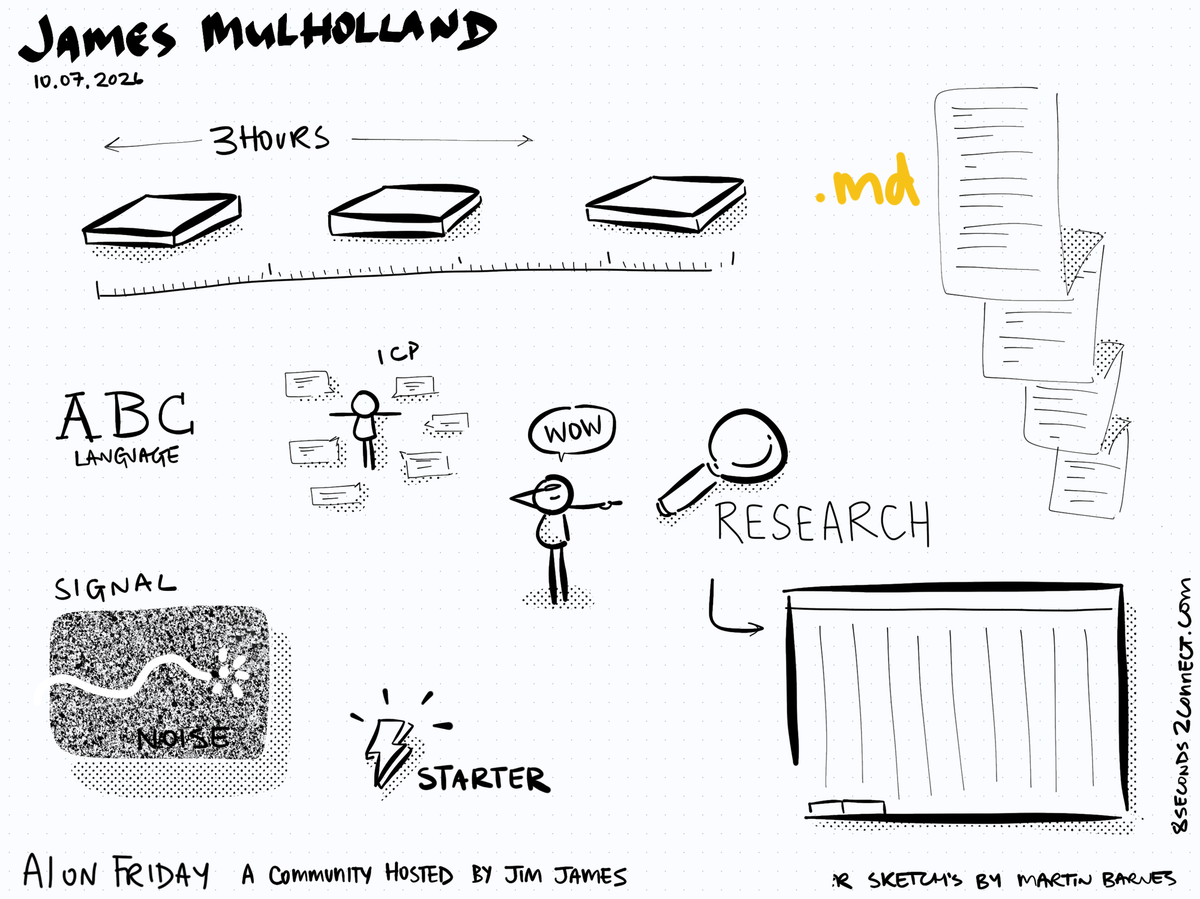
This is the approach used by James Mulholland CEO of AIZEE AI aka Clevaa , who shared his Claude enabled workflow at our AI on Friday session. AIZEE is an AI receptionist for websites, and James was targeting estate agencies in the UK.
Here's how the system works, and why the boundary between the two roles matters so much.
The shape of a campaign
A single outreach campaign — one location, or one vertical — breaks into four stages, and the time investment is deliberately lopsided.
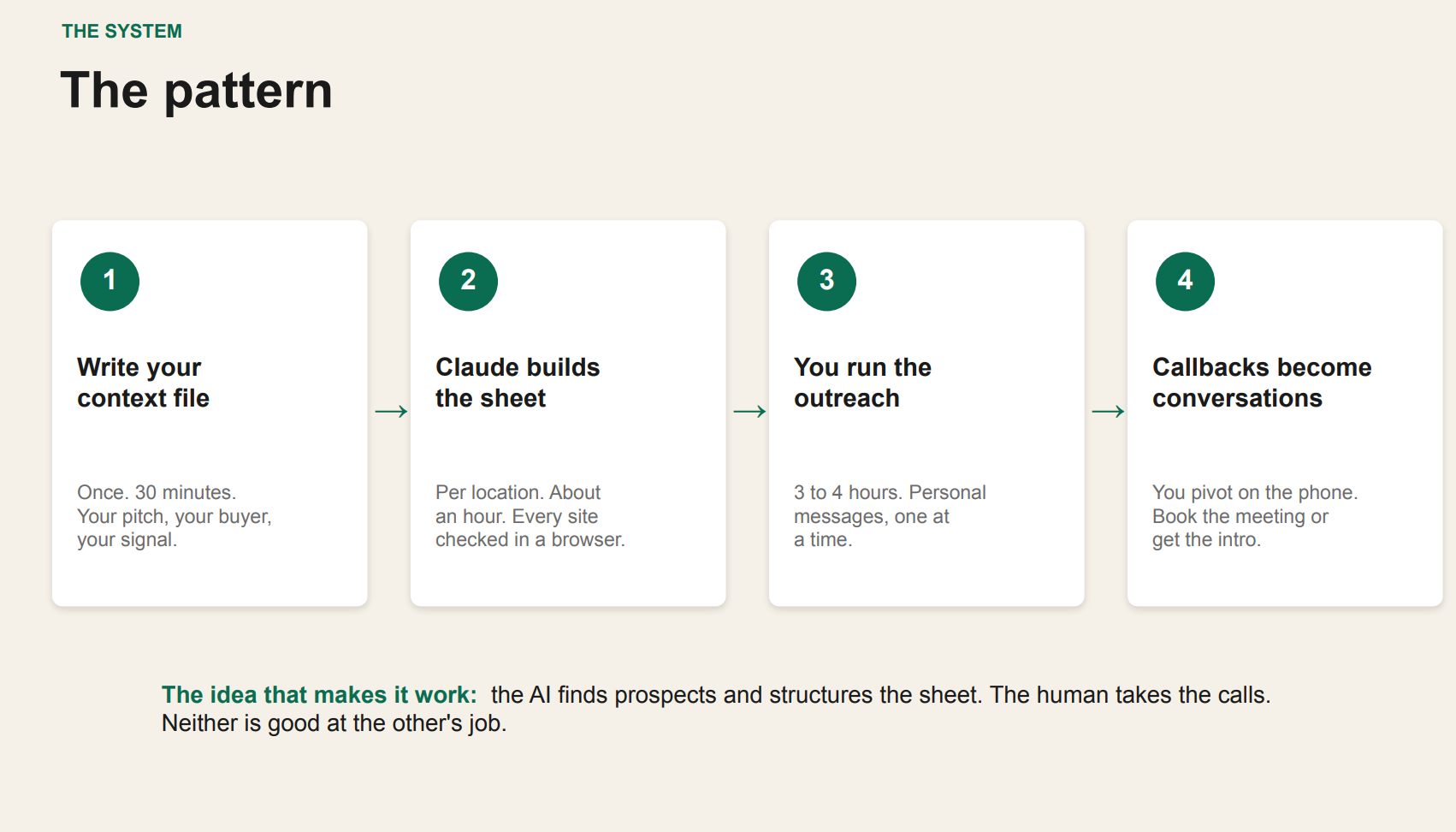
Write your context file. This happens once, and takes about half an hour. It's a plain document covering what you sell, who buys it, what signal to look for on a prospect's website, and how you'd pitch it. It's the one piece of setup that everything else depends on.
Claude builds the sheet. Roughly an hour per location. Using a browser-connected AI agent, Claude opens every prospect's actual website — not a scraped database, the real site — and checks it against the criteria in the context file.
You run the outreach. Three to four hours of focused, personal messaging — one prospect at a time.
Callbacks become conversations. This is where deals get made — on the phone, pivoting from the message you sent to a live conversation.
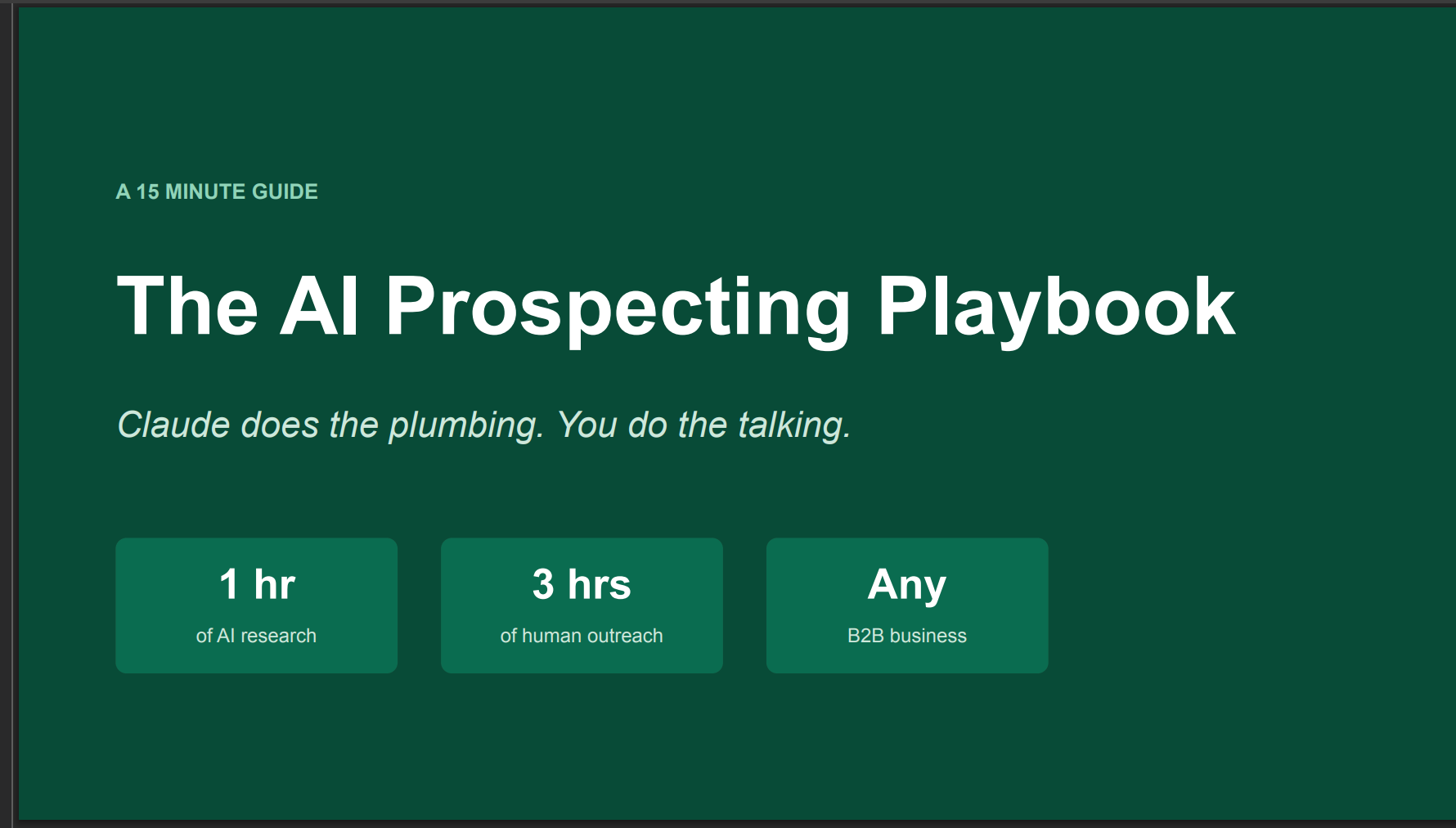
The ratio is the point: one hour of AI research buys three to four hours of well-targeted human outreach. The AI's job isn't to replace the conversation. It's to make sure every conversation you have is with someone worth talking to.
The one thing that makes it work: pick a signal
The core move in this system is choosing a single, checkable thing on a prospect's website that tells you exactly how to open the conversation.
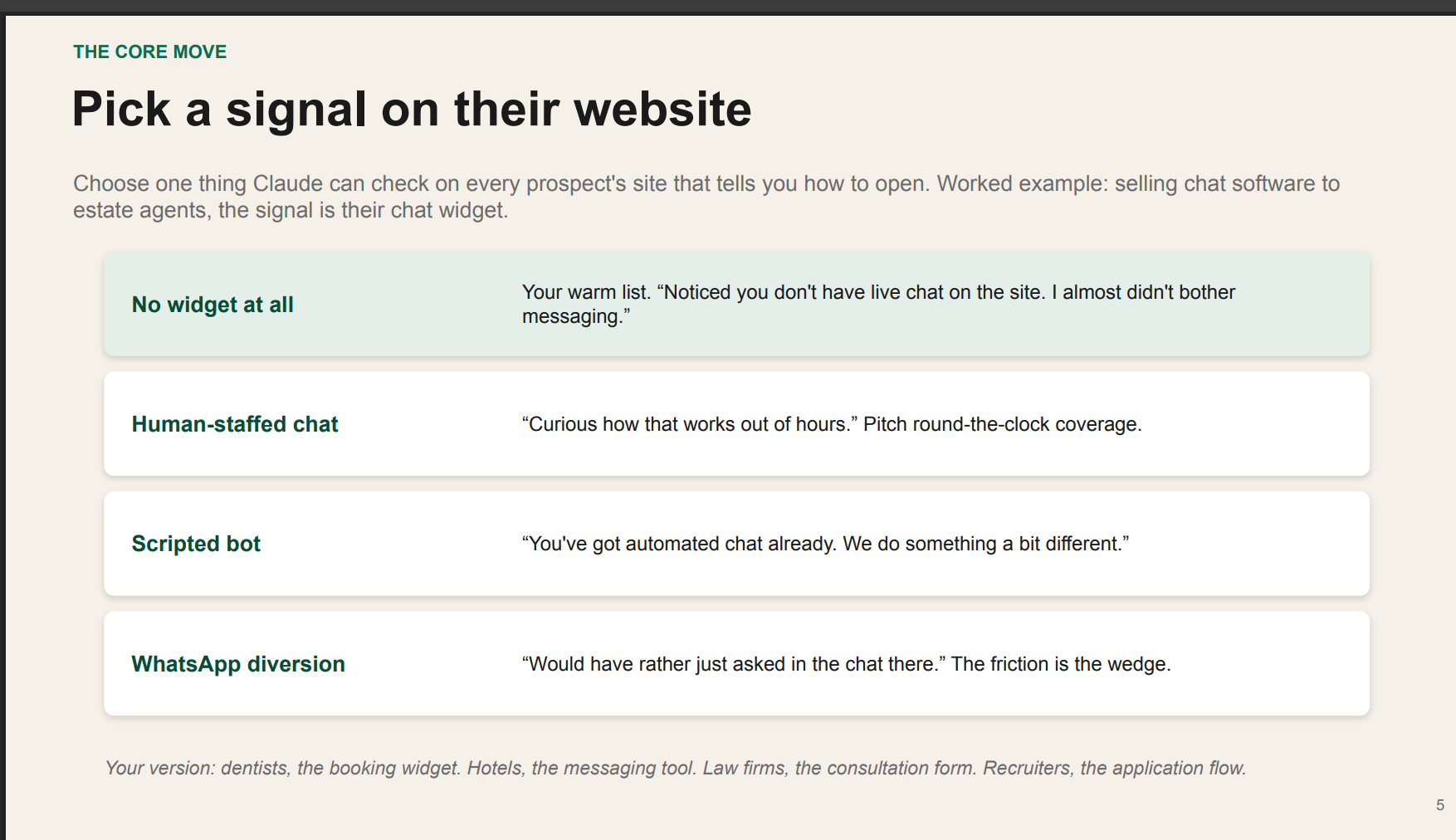
Take a business selling chat software to estate agents. The signal is simple: does the site have a live chat widget, and if so, what kind?
- No widget at all — this is your warm list. The opener writes itself: "Noticed you don't have live chat on the site. I almost didn't bother messaging."
- Human-staffed chat — pitch round-the-clock coverage: "Curious how that works out of hours."
- A scripted bot — differentiate: "You've got automated chat already. We do something a bit different."
- WhatsApp diversion — the friction itself is the wedge: "Would have rather just asked in the chat there."
The same logic transfers to almost any B2B offer. For a business selling to dentists, the signal might be the booking widget. For hotels, the messaging tool. For law firms, the consultation form. For recruiters, the application flow. Whatever you sell, there's usually a single visible fact on a prospect's site that tells you exactly which conversation to start.
Detection has to be done properly — twice
This is the part that's easy to skimp on, and expensive to skimp on.
Checking whether a website has a chat widget sounds trivial, but a single pass — scanning the site's code for known chat providers — misses roughly one widget in five. Custom-built or unusual implementations don't show up in a script scan.
The fix is a second pass: looking for any visible floating element in the bottom-right corner of the page — the classic chat-launcher position — regardless of what's powering it. On a real campaign, this second pass caught three widgets the first pass missed entirely.
Skip that re-scan and you'll tell a prospect they have no live chat when they do. That's not a minor error — it's instant credibility loss, and it undoes the whole premise of a personalised opener.
The human part: submit, wait, don't overload yourself
Once the sheet is built, the outreach itself follows a tight, deliberately unhurried cadence:
- Pick a row, starting with the warm list, and open the contact form.
- Match the opener to the signal that row already tells you.
- Send a genuinely personal note — real name, real detail, opener plus pitch.
- Wait five to ten minutes with the phone in hand. No call? Move to the next row.
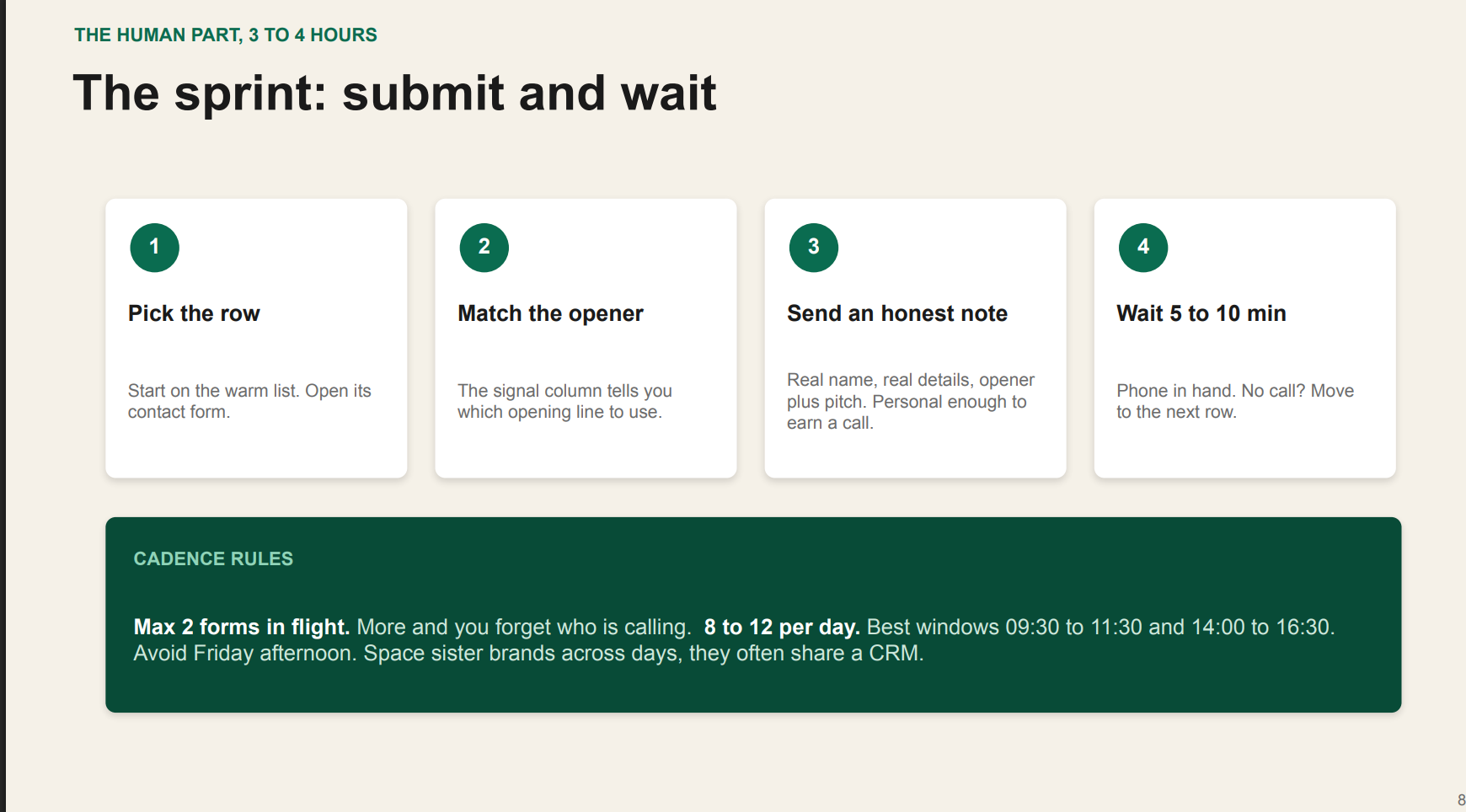
The cadence rules exist for a reason: a maximum of two forms in flight at once, because beyond that you lose track of who's about to call you back. Eight to twelve submissions per focused block, concentrated in the windows when people actually answer — mid-morning and mid-afternoon tend to outperform. Friday afternoons are best avoided. And if you're running outreach to sister brands or franchises, space them across different days, since they often share the same back-office system and will notice a cluster of submissions.
The callback: 90 seconds that decide everything
When the phone rings back, the entire interaction typically resolves in under two minutes, and it runs down one of three branches.
Open as yourself, thank them for the quick call, then pivot with something like: "I noticed the thing about your site I mentioned in my note. That's actually what we do. Probably not your call directly, but who owns that side of the business?"
- "That's me" — keep going. Offer a fifteen-minute slot and send the booking link within five minutes of hanging up.
- "Speak to [name]" — ask for a warm introduction by email, there and then, while you're still on the phone.
- "We're sorted" — don't give up yet. One wedge question — "What happens to the enquiries that come in after 6pm?" — often reopens the conversation, because the honest answer usually exposes the gap you're there to fill.
Whatever the outcome, capture it within two minutes of hanging up: caller name, role, direct line, who owns the function, any warm intro promised and by when, the pain point they mentioned, and the next step — always something concrete and timed, never left vague.
What good looks like, and what to fix when it isn't
For a well-run three-to-four-hour outreach block, the benchmarks are roughly:
- 8–12 form submissions
- 40–60% same-day callback rate on well-personalised notes
- 15–25% of those callbacks converting to a booked next step
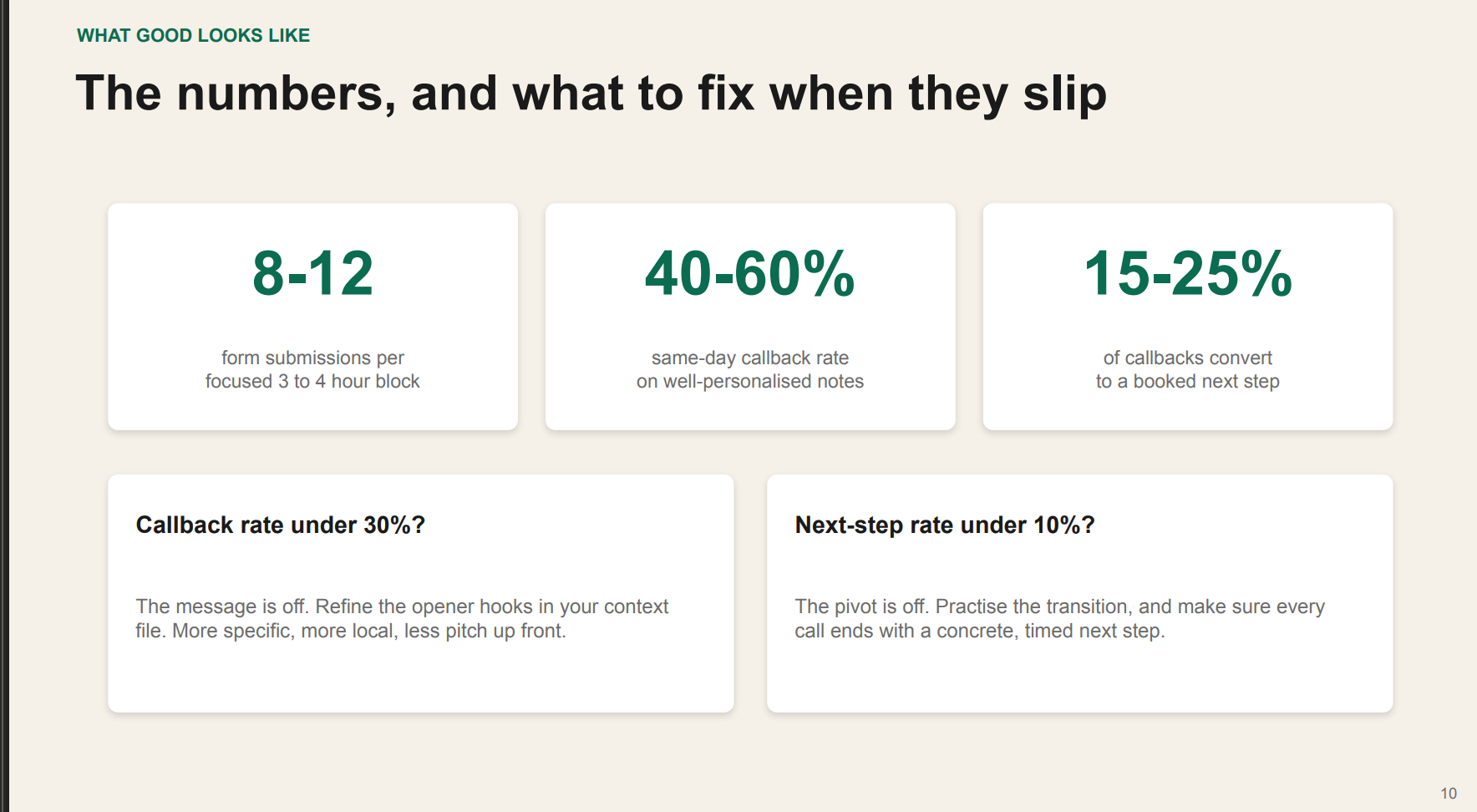
If the callback rate falls below 30%, the diagnosis is usually the message, not the market — the opener hooks need to be sharper, more specific, less pitch-heavy up front. If callbacks are coming in but the next-step rate is under 10%, the problem has shifted to the pivot itself — the transition from "thanks for calling" to "here's why I called" needs practising, and every call needs to end with something concrete on the calendar, not a vague "I'll follow up."
Adapting it to your own business
Three things change between businesses. Everything else stays exactly the same.
- The signal — the one thing on a prospect's site that tells you how to open.
- The opener hooks — the specific line for each state that signal can be in.
- The pitch paragraph — the 50–70 words that sit in the middle of every message.
Detection, cadence, the callback pivot, capture, and follow-up all transfer as-is. The system doesn't need reinventing for a new vertical — it needs three inputs swapped out.
Worth reviewing on a fortnightly rhythm: which opener is converting best (sharpen its wording), who's calling back fastest (and who never replies at all — drop those segments), which time window is winning (concentrate submissions there), and what objections keep coming up (turn each one into a new wedge question for the next round).
The rules that keep it honest
A system like this only holds up if a few boundaries are respected:
- Be who you are. Real name, real company, real reason for messaging. The personal note is what earns the callback — not a disguise. Never pose as a customer or invent an enquiry that didn't happen.
- Humans send, always. The AI researches and drafts. A person reviews, submits the form, and takes the call. There's no bulk automation in this system — that's not an accident, it's the whole point.
- Don't pad thin lists. If a location or vertical turns up fewer prospects than expected, broaden the geography or the tier rather than let the AI stretch the list with wrong-fit rows. Padding wastes the three to four hours that matter most.
- Respect the data. Identify yourself clearly, honour opt-outs immediately, keep volume low per company, and re-verify anything that looks stale before sending.
The takeaway
Set the context file up once. Reuse the research process for every new campaign, changing only the industry and the location. The AI's job is the field research — walking every prospect's site, checking it against the signal, structuring what it finds.
Your job is the conversation. Kept in that order, the system scales without ever sounding like it was written by a machine — because the parts a prospect actually hears were never written by one.
More like this
If you want to join an invitation only community of entrepreneurs adopting AI into their business, then click this link:


